

Types of Robots: Classification, Examples and Real-World Uses
Learn the main types of robots: articulated, SCARA, Cartesian and delta arms, wheeled, legged and aerial robots, with their uses and runnable Python examples.
Walk through a large mithai factory on the Dewas road outside Indore. At one end a machine squirts exactly 40 grams of batter into each mould. In the packing hall, a fast arm with three thin legs flicks pieces of soan papdi into trays, about two a second.
A small cart follows a painted line to carry crates to the loading dock, and on the roof a drone checks the solar panels once a week.
All four are robots, yet they look nothing alike. The batter dispenser only needs to move in straight lines. The packing arm needs speed over a small area. The cart needs to roll across a big floor, and the drone needs to fly.
That is the whole idea behind classifying robots: the job decides the body. Once you know the main robot types and why each exists, you can look at any task and guess which robot would do it well.
What are the main types of robots?
Map the factory onto robotics vocabulary. The batter machine is a Cartesian robot, the packing arm is a delta robot, the cart is a wheeled mobile robot (more exactly, an automated guided vehicle) and the drone is an aerial robot.
The first two are bolted to the floor and are called fixed or stationary robots. The last two move around, so they are mobile robots.
The types of robots are categories based on how a robot moves, what work it does and how independently it decides, and the most basic split is between fixed manipulators that work in one place and mobile robots that travel.
If you are new to the field, the what is robotics guide explains the sense–think–act loop that every one of these types runs, whatever its shape.
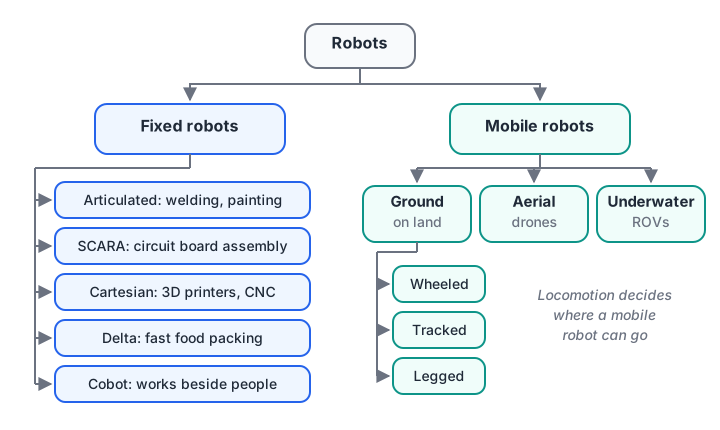
One practical classification tree. Fixed robots are grouped by arm geometry, mobile robots by how they move.
Types of industrial robot arms
An industrial robot is a programmable arm with three or more axes, used in manufacturing. The number of independent joints is its degrees of freedom (DoF). Three DoF can put a tool anywhere in a box of space; six DoF can also point it in any direction, which welding and painting need.
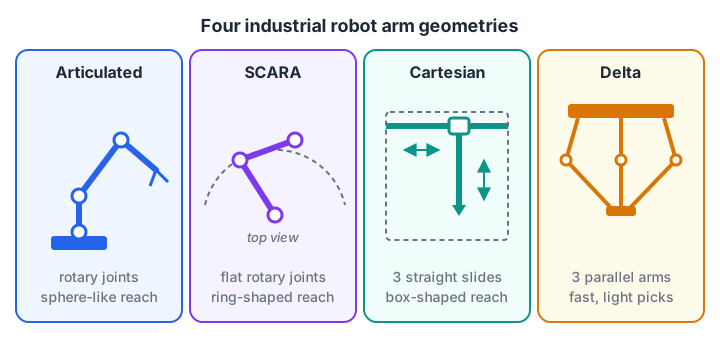
The four classic arm geometries. The joint types decide the shape of the space each arm can reach.
| Arm type | Joints | Workspace shape | Strengths | Typical jobs |
|---|---|---|---|---|
| Articulated | 4 to 7 rotary joints | Roughly a sphere | Reaches around obstacles, any tool angle | Car body welding, painting, machine loading |
| SCARA | 2 rotary in a flat plane, 1 vertical slide, 1 wrist twist | Flat ring, like a thick washer | Fast, stiff vertically, cheap for its speed | Screwing, placing parts on circuit boards |
| Cartesian (gantry) | 3 straight slides (X, Y, Z) | Rectangular box | Simple maths, very accurate, scales to big sizes | 3D printers, CNC routers, dispensing, palletising |
| Delta (parallel) | 3 arms meeting at one small plate | Dome under the robot | Extremely fast picks of light objects | Food packing, sorting on conveyors |
| Collaborative (cobot) | Usually 6 rotary joints | Like articulated, smaller | Force limits so it can work beside people | Small-batch assembly, inspection, lab work |
Why the joint type matters
A rotary joint swings, so arms built from rotary joints reach in curves and their maths needs sines and cosines. A straight slide, called a prismatic joint, moves in a line, so a Cartesian robot's position is just its three slide readings.
That simplicity is why your 3D printer is Cartesian and a car plant's welding robot is articulated. You will meet the maths behind this in robot kinematics.
Compare two workspaces in Python
This block compares how much floor area a small Cartesian table and a SCARA arm can cover. A two-link SCARA reaches a ring between the difference and the sum of its link lengths.
import math

# Cartesian table: X travel 600 mm, Y travel 400 mm
cart_area = 600 * 400

# SCARA: two links of 325 mm and 275 mm, joints can turn a full circle
l1, l2 = 325, 275
outer = l1 + l2            # arm fully stretched
inner = abs(l1 - l2)       # arm folded back on itself
scara_area = math.pi * (outer**2 - inner**2)

print(f"Cartesian reach: {cart_area/1e6:.2f} square metres, a rectangle")
print(f"SCARA reach:     {scara_area/1e6:.2f} square metres, a ring")
print(f"SCARA covers {scara_area/cart_area:.1f}x the area from a single mounting point")
print(f"Dead zone at the SCARA base: radius {inner} mm")
The SCARA covers almost five times the area while bolted to one spot, but it leaves a 50 mm dead zone at its base and its accuracy changes across the ring. The Cartesian table covers less ground with the same accuracy everywhere. Neither is "better"; they suit different jobs.
Quick check
A factory needs a robot to place 120 light biscuits per minute from a conveyor into trays. Which type fits best?
Delta robots use light parallel arms, which makes them extremely fast for light pick-and-place work over a small area.
Types of mobile robots by locomotion
Mobile robots are classified mostly by how they get around, because locomotion decides where they can go and how hard they are to control.
| Locomotion | How it steers | Good at | Weak at | Examples |
|---|---|---|---|---|
| Differential drive | Two wheels at different speeds | Turning on the spot, simple control | Rough ground | Floor cleaners, hobby robots, warehouse carts |
| Car-like (Ackermann) | Front wheels turn | Speed, outdoor roads | Tight spaces, needs room to turn | Self-driving cars, campus delivery |
| Omnidirectional (mecanum or omni wheels) | Special rollers let it slide sideways | Moving in any direction without turning | Bumps, wheel wear | Factory carts in narrow aisles, robot contests |
| Tracked | Two tracks at different speeds | Mud, stairs, rubble | Efficiency, wheel slip makes position hard to estimate | Bomb disposal, pipe inspection |
| Legged | Leg placement | Uneven ground, steps | Complex control, battery life | Inspection quadrupeds, research humanoids |
| Aerial | Rotor speeds | Height and coverage | Flight time, payload | Crop spraying, surveys, tower inspection |
| Underwater | Thrusters | Places divers cannot go | Radio does not work under water | Hull and dam inspection |
The two-wheel differential drive is the beginner's favourite because two motors and one caster are enough to go anywhere on a flat floor. The differential drive robot tutorial works through its maths, and the obstacle-avoiding robot project builds one.
Quick check
Which robot type can move sideways without first turning?
Mecanum wheels have angled rollers, so changing each wheel's speed and direction lets the robot slide in any direction.
Types of robots by application
A second way to group robots is by the work they do. This is how industry reports and job listings usually talk about them.
- Industrial robots work in factories: welding, painting, assembly, packing, palletising. Arms dominate here.
- Logistics robots move goods: automated guided vehicles that follow lines or markers, and autonomous mobile robots that plan their own routes around a warehouse.
- Service robots work around people: floor cleaners, hotel and hospital delivery carts, reception robots.
- Medical robots assist surgeons with very precise, scaled-down motion, or help with rehabilitation and pharmacy dispensing.
- Field robots work outdoors: agricultural sprayers and weeders, mining and construction machines, inspection drones.
- Exploration and defence robots go where people cannot: space rovers, deep-sea vehicles, bomb disposal.
- Educational and hobby robots teach the basics: line followers, robot kits, small arms.
Types of robots by autonomy level
The third useful split is how much the robot decides on its own.
- Teleoperated: a person controls every move, as with a remote-controlled bomb disposal robot.
- Pre-programmed: the robot repeats a taught path exactly and does not sense much. Classic welding cells work this way, behind safety fences.
- Reactive: the robot follows simple rules from its sensors, such as "turn when something is closer than 25 cm".
- Autonomous: the robot builds a picture of its surroundings, plans, and adapts, like a warehouse robot that routes around a dropped box.
Choose a robot type for a job in Python
This toy chooser encodes some of the trade-offs from the tables as simple rules. It is a learning aid, not an engineering tool, but it shows how requirements narrow the options.
jobs = [
    {"name": "pick sweets off a conveyor", "moves": False, "speed": "high", "payload_kg": 0.2, "terrain": None},
    {"name": "weld a car door", "moves": False, "speed": "medium", "payload_kg": 10, "terrain": None},
    {"name": "carry crates across a warehouse", "moves": True, "speed": "medium", "payload_kg": 50, "terrain": "flat"},
    {"name": "inspect a muddy construction site", "moves": True, "speed": "low", "payload_kg": 5, "terrain": "rough"},
    {"name": "survey a 20-acre soybean field", "moves": True, "speed": "high", "payload_kg": 2, "terrain": "air"},
]

def choose(job):
    if not job["moves"]:
        if job["speed"] == "high" and job["payload_kg"] < 1:
            return "delta robot"
        return "articulated arm" if job["payload_kg"] > 5 else "SCARA arm"
    if job["terrain"] == "air":
        return "aerial robot (multirotor drone)"
    if job["terrain"] == "rough":
        return "tracked or legged robot"
    return "wheeled mobile robot (differential drive)"

for job in jobs:
    print(f"{job['name']:<36} -> {choose(job)}")
Try adding a job of your own, such as moving a camera along a 2-metre rail. If the if chain feels unfamiliar, revise if-else in Python first.
Common mistakes when classifying robots
- Calling every automatic machine a robot. A washing machine follows a timer. A robot senses, decides and acts in a loop, and can be reprogrammed for new tasks.
- Thinking humanoids are the default. Most working robots are arms and carts because a specialised body is cheaper and more reliable than a general one.
- Counting motors instead of degrees of freedom. A gripper's open-close motor is not usually counted as an arm axis, and some joints use two motors together.
- Ignoring the environment. A wheeled robot that works perfectly in the lab may get stuck on a 2 cm threshold. Terrain decides locomotion first.
- Judging a robot by its outer shape. Two robots that look different may share the same parts inside; components of a robot lists them.
- Mixing up AGVs and AMRs. An automated guided vehicle follows fixed lines or markers; an autonomous mobile robot plans its own path and can route around obstacles.
Key takeaways
- Classify robots three ways: by locomotion, by application and by autonomy level.
- Fixed arms are grouped by geometry: articulated, SCARA, Cartesian, delta and collaborative.
- Joint types decide the workspace shape: rotary joints give curves, prismatic joints give boxes.
- Mobile robots are grouped by locomotion; differential drive is the easiest to start with.
- The job and the environment choose the body, not the other way round.
FAQ
What are the 5 main types of industrial robots?
The five main industrial robot types are articulated, SCARA, Cartesian (gantry), delta (parallel) and collaborative robots. Some lists also include cylindrical and polar arms, older designs you still see on machine-loading lines. Each type's joint layout gives a different workspace shape, speed and payload range.
Which type of robot is best for a beginner to build?
A two-wheel differential drive robot is the best first build. It needs only two DC motors, a caster wheel, a motor driver and a microcontroller, and it teaches sensing, decisions and motor control in one project. A small 3 or 4 servo arm is a good second project.
What is the difference between a robot arm and a mobile robot?
A robot arm is fixed in place and moves a tool through a limited workspace, so its main problems are reach, precision and speed. A mobile robot moves its whole body through the world, so its main problems are knowing where it is, avoiding obstacles and planning routes.
Are drones considered robots?
Yes. A drone that senses its surroundings with GPS, an IMU or cameras, and controls its motors from those readings, is an aerial robot. A purely hand-flown toy with no onboard sensing is closer to a remote-controlled vehicle than a robot.
Can I learn to build different types of robots in Indore?
Yes. Debugshala's hands-on robotics training at Old Palasia starts with Arduino and ESP32 basics, motors and sensors, then builds line-follower and obstacle-avoiding robots before a final robot project. Classes are offered in English and Hindi, and you can attend a free demo class first.
How do I practise the basics before a robotics course?
Strengthen your Python first, because most robot logic is loops, conditions and functions. Write small programs like the chooser above, then check your loop and condition skills on Debugshala Test to check your understanding of loops and conditions before you move to hardware.
From the team behind this site
Go further with the Robotics Course at Debugshala
These tutorials are written by Debugshala, a training and placement institute at Old Palasia, Indore. The classroom course adds live mentoring, real projects and interview preparation.
- Offline classes at Old Palasia, Indore
- Free demo class before you pay
- Non-IT, fresher and year-gap friendly
- Placement assistance
700+ students placed · 200+ hiring partners · 4.9★ Google rating
